

(805) 499-3770830 Tourmaline Dr, Newbury Park, CA 91320Open 9:00 AM – 6:00 PM Tuesday – SaturdayClosed Monday and Sunday
Last Updated: November 2, 2026
Quick Summary
To choose your first motorcycle, match the bike to how you actually plan to ride rather than to how it looks, then confirm fit and control. For most new riders the practical engine window is roughly 250cc to 650cc, and a bike you can flat-foot and hold up safely matters more than any spec sheet.
The best way to choose your first motorcycle is to match it to how you actually plan to ride, not to the bike that looks best in a showroom. Many new riders fall for a style before they define their riding, which reverses the right order.
Start with three honest questions:
Your answers point to a category. A cruiser suits relaxed highway miles. A sportbike rewards smooth pavement and precise inputs. A dual-sport handles mixed surfaces. A standard motorcycle does a little of everything and is often the easiest place to begin.
Use this list before you visit any dealership. It turns a vague wish into a concrete plan.
A first motorcycle for beginners should feel manageable from day one. If a bike intimidates you in the showroom, it will intimidate you in traffic. Trust that instinct.
Displacement, measured in cubic centimeters (cc), is the total volume swept by the engine’s pistons. It is the clearest single number for judging whether a bike suits a new rider, but it is not the only one, and treating it as a proxy for danger is the most common beginner mistake.
Smaller displacement generally means lighter weight, gentler throttle response, and more forgiving clutch control. Larger displacement brings more torque and horsepower, which demands smoother inputs. For most new riders, the practical window sits between roughly 250cc and 650cc, with the lower end favoring city riding and the upper end suiting riders who will spend real time at highway speed.
Two related specs matter as much as cc:
A beginner motorcycle engine size conversation is really a conversation about control, not speed. That is why the cc number alone can mislead in both directions:
Ask about fuel efficiency and braking system features too. ABS (Anti-lock Braking System) is a genuine confidence aid for new riders, and it is worth prioritizing. Traction control and ride-mode settings that soften throttle response are also worth asking about on newer models.
Watch out: a bike that feels tame in a parking lot can feel very different at highway speed, and a bike that feels thrilling in a showroom can punish a new rider in stop-and-go traffic. Judge displacement against the riding you actually plan to do, not the riding you imagine.
The specs that matter most for a new rider, and what each one actually affects.
| Spec | What it affects | Note for new riders |
|---|---|---|
| Displacement (cc) | Overall engine size and character | Practical window roughly 250cc to 650cc |
| Torque | How hard the bike pulls away from a stop | More torque demands smoother inputs |
| Horsepower | Top-end performance | Rarely needed at first |
| Power-to-weight ratio | Real-world manageability | Predicts manageability better than either figure alone |
| Seat height | Whether you can hold the bike up | Lower seat height eases low-speed maneuvering |
| Curb weight | Low-speed maneuvering | Lighter weight makes maneuvering easier |
| ABS | Braking confidence | A genuine confidence aid worth prioritizing |
Motorcycle fit and seat height determine whether you can control the bike at a stop, and that matters more than any spec sheet. A bike you cannot hold up safely is the wrong bike, however good it looks. Once the bike feels manageable at a stop, choosing a dirt bike helmet that fits securely is another part of staying in control.
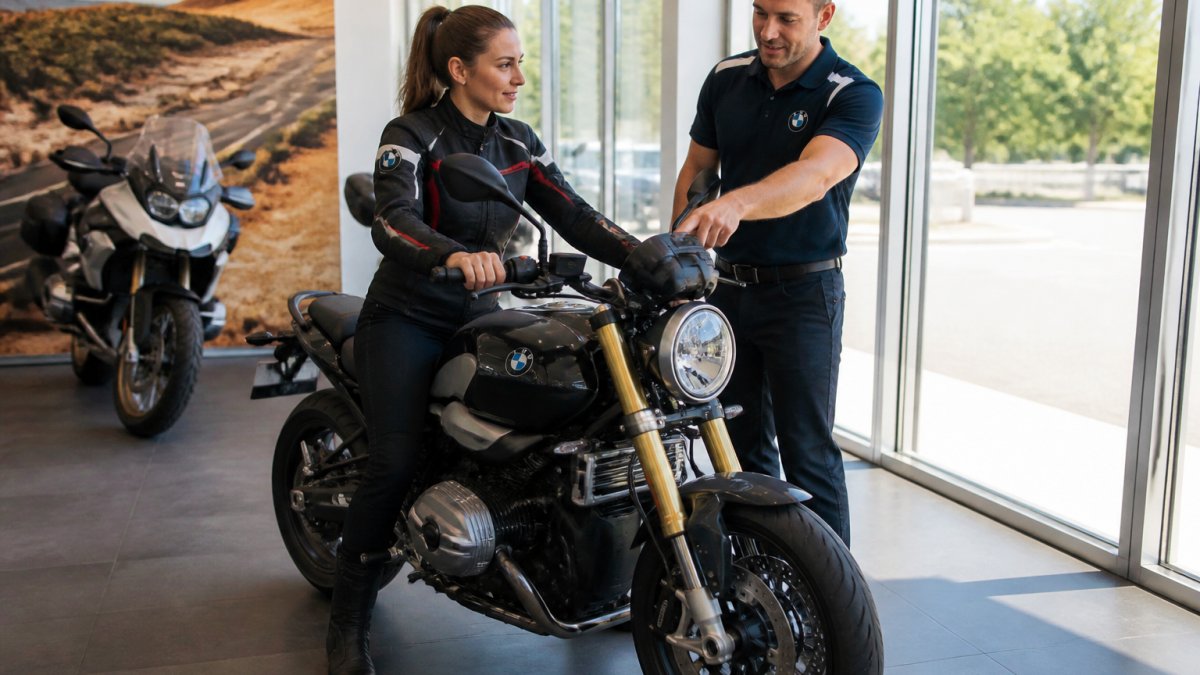
Here is how to judge fit in person:
Motorcycle ergonomics vary widely between categories, so sit on several. A lower seat height and a lighter curb weight make low-speed maneuvering far easier. That is where new riders struggle most.
A pre-owned motorcycle often makes sense for a first bike because a drop costs less emotionally and financially. New bikes bring warranty coverage and a known history, which many riders value more.
Weigh both sides honestly:
New
Pre-owned
One published buying guide makes a point worth repeating: plan on buying at least two motorcycles over time. Your first bike is a starting point, not a lifelong commitment. That reframing takes pressure off the decision.
If you buy used, insist on a documented inspection and a clear service history. A cheap bike with hidden problems is never a bargain.
How to choose a motorcycle helmet comes down to fit, certification, and the right gear for your riding style. Gear is not optional equipment. It is part of the bike.
Safety context matters here. According to the Insurance Institute for Highway Safety motorcycle safety research, the number of motorcyclist deaths per mile traveled in 2024 was almost 27 times the number of deaths in cars, citing NHTSA data.
Build your gear kit in this order:
Try helmets on in person. Fit varies by brand and shell shape, and a loose helmet protects far less. Replace any helmet that has taken a hard impact.
The purchase price is only part of ownership, and the extras surprise most new riders. Most guides stop at the sticker price; the useful exercise is building a total cost of ownership picture before you commit, so the first year does not produce budget shocks.
Plan for these recurring and one-time costs:
A practical way to plan is to sort every cost into three buckets:
Tires deserve special attention because they wear faster on motorcycles than on cars and are the single most commonly underestimated recurring cost. Ask the dealer for the recommended replacement interval and the typical cost of a set for the model you are considering. Ask the same question about valve inspections and major service intervals, those are the line items that arrive years into ownership and catch riders off guard.
Watch out: a low purchase price on a used bike can be erased by deferred maintenance. A documented service history is worth more than a small discount, and a pre-purchase inspection is cheaper than the first surprise repair.
Ask the dealer for a written estimate of routine service before you buy, so the maintenance picture is clear up front. Readers weighing a premium brand can also check whether BMW motorcycle maintenance is expensive before committing.
A test ride is the final filter, and it settles questions no spec sheet can answer. Even a static sit tells you a lot about motorcycle fit and seat height.
During a test ride, pay attention to:
Come prepared with your license, endorsement, and gear. Ask about the dealership’s test ride policy in advance.
If you are not ready to ride, ask for a static fit session. Sitting on several bikes back to back reveals comfort differences fast.
Choosing a first motorcycle is a decision you can make with confidence rather than guesswork. BMW Motorcycles of Ventura County offers a no-pressure sales approach, professional guidance on motorcycle selection and technology setup, and new and pre-owned BMW motorcycles backed by the BMW Motorrad warranty and 24-hour roadside assistance. Our team can help you compare models and arrange a test ride. Get started with BMW Motorcycles of Ventura County and find the bike that matches how you actually ride.
A good first motorcycle for beginners is light, predictable, and easy to control. Look for a standard, cruiser, or dual-sport with a moderate engine displacement, a low curb weight, and a seat height that lets you get both feet down. Avoid high-strung sportbikes and heavy touring models. Sit on several bikes and take a test ride before deciding. A beginner-friendly bike should feel manageable at low speeds and in stop-and-go traffic, not intimidating.
It depends on the bike, not just the number. A 600cc engine in a heavy cruiser or a detuned standard can be manageable, while a 600cc supersport is built for high performance and is a poor choice for a new rider. Focus on horsepower, torque delivery, weight, and riding position. A moderate-displacement standard or cruiser with smooth throttle response is a safer starting point than a race-derived sportbike.
Both can work. A used bike costs less upfront and is less painful to drop, but it requires a careful pre-owned inspection of the chain, brakes, tires, and frame. A new bike comes with a warranty, known service history, and dealer support, which many beginners value. If you buy used, have a mechanic inspect it first. If you buy new, confirm what the warranty covers and what maintenance is required.
Fit comes down to seat height, reach to the controls, and weight. You should be able to get the balls of both feet on the ground, or at least one foot flat, and reach the levers without stretching. The bike should feel balanced when you lift it off the kickstand. Adjustable seats and suspension help, but the basic ergonomics must suit your body. Sit on several models before you commit.
While great effort is made to ensure the accuracy of the information on this site, errors can occur. Please verify all pricing and installed equipment information with a customer service representative. This is easily done by calling us or visiting us at the dealership.
We improve our products and advertising by using Microsoft Clarity to see how you use our website. By using our site, you agree that we and Microsoft can collect and use this data. Our privacy statement has more details.

Save your favorite vehicles for later viewing on your desktop or mobile devices.
Keep track of all the vehicles you've viewed for a better car shopping experience.
Narrow your search by comparing your favorite vehicles.

